☼HERITAGE
noun
<an inheritance>
After the OELP trip to China, I have certainly learnt a great deal about China's heritage! I have learnt that China has a rich and vibrant heritage and inheritance of knowledge and culture the past 5000+ years. There is a dilemma of cultural heritage conservation and economic development and now, I have learnt that not only economic development is important to a country, but heritage conservation is extremely vital as well. Heritage is important to preserve as firstly, heritage can give people a connection to certain social values, beliefs, religions and customs. This will allow them to identify with others of similar mindsets and backgrounds.
Secondly, cultural heritage can provide an automatic sense of unity and belonging within a group and allows us to understand our ancestors' generations, learning more about the history of our roots.
What can Singapore do to make the local arts scene more vibrant and to further develop our heritage? The government can encourage community participation and engagement and also provide non-ticketed and free attendance for heritage events, encouraging more to come forward.
☼教育
在树人中学,我们发现中国的同学比较有信心。例如,当他们的老师在课堂上提问时,他们都纷纷举手要回答。我们可以从他们学习,在课堂中用于发言和回答老师所问的问题。他们也十分友好,当看到我们时,他们会向我们挥手。
中国和新加坡的教育体系都十分相似;我们都有小学到大学的系统,也会分发功课和举办考试。可是,我发现中国的学风都较个人主义,学校里并没有许多小组专题作业;相反,新加坡学校里有很多小组专题作业。我认为这是良好的,因为这样,我们可以学习怎样与他人沟通,并欢迎不同的意见。这在日后我们踏进社会时,会有不少好处。
新加坡应如何从中国的教育体系学习?在中国,大多数学生都花费长时间来学习;这会培养他们辛勤吃苦的美德。我们如果学会在学校里有决心学习,以后在社会上我们也会有决心克服任何困难。
我以前曾认为新加坡的教育体系有点受限,因为我们每天都有大量功课,但见过中国的学校后,我对新加坡的教育体系感到十分满意。我们被给予大量的自由,甚至可以带手机上学。我学到,我们应该为我们所拥有的而感到满足和感激。
☼ECONOMY
After the OELP trip to China, I have learnt that China has one of the world's fastest-growing major economy. It is a global hub for manufacturing and exporting. China's economic importance has grown vastly and I believe that we should learn from their rapid economic development! What can Singapore learn from a rising China? Even at the market exchange rate, China overtook Japan in 2010 as the world's largest economy.
China has globalised and industrialisation plays a big role in it. In Shanghai, we saw many banks and hotels. All these are built as many foreigners come every day to China for business purposes which will boost China's economy. Hence it will only make sense if China has enough resources to host these businessmen. These international banks and hotels have attracted vast numbers of businessmen to come to China, hence helping to improve China's current economy.
☼历史
去过了上海博物馆,我对中国的历史的认知更加广泛了。我学到中国是一个历史悠久的国家,有超过5000多年的繁华历史。例如,传统陶瓷拥有历史文化的考古价值和艺术价值,都对中国的历史做出了贡献。
传统书法是中国汉字的书写艺术,也是在中国土生土长的艺术。那也是中国文化的基本要素。还有中国传统家具,具有中国古典风格。国画就是传统的绘画,是琴棋书画的四艺之一。
总之,在这一浸濡之旅上,我学到了许多关于中国历史的知识,真是让我获益不浅。
☼IDENTITY
I have gotten to know about China's traditional cultural values and national identity. I have certainly also learnt a lot more about contemporary China's way of life and to respect these customs and values which are quite different than what we are normally used to in Singapore.
China's identity is a truly unique and intriguing one! I really hope that I have more opportunities to learn more about China's identity in the future. :)
☼中国的文化
在这一浸濡之旅上,我更加认识到了中国的早期文化还有近代中国文化的发展。
我也加以了解了中国的习俗和中国人民的日常生活,如他们的服饰装扮风格和饮食。这次的OELP中国浸濡之旅真的使我们学到了许多。我们学会了接受与尊重与我们不同的文化。这次机会也使我们学会珍惜我们在新加坡所拥有的。我也很感激立化给我们这么一个难得的机会去中国进一步认识他们的风土人情,在多方面了解当代中国和它的悠久历史。
☼Thank you for reading!

Showing posts with label Zi Qiu. Show all posts
Showing posts with label Zi Qiu. Show all posts
Sunday, 14 June 2015

Saturday, 13 June 2015
✈ Individual Daily OELP Reflections
✧DAY 1, 26th May
It was finally the first day of OELP! I remember waking up extra early to go to Changi Airport for our flight departing Singapore for Shanghai. That moment was quite surreal as I couldn't believe that our trip to China had finally officially begun. At the airport, we bid goodbye to our parents. I was feeling rather scared about going overseas without my family, but at the same time excited for the trip as I would be travelling with my friends for the first time as well!
Upon our arrival in Shanghai, we left for a cultural visit to the infamous "The Bund", or 外滩, with the guidance of our tour guide 包导游. He was very kind and patient, and told us to call him 包导. On the bus ride to The Bund, I noticed that there was a large flow of cars on the road and generally in the city. I also noticed that there were a massive amount of tall buildings and skyscrapers in Shanghai. According to 包导, the 1990's were the golden era for Shanghai. Many foreigners had come to Shanghai to open restaurants, for example Italian and Belgium restaurants.
We saw many banks and hotels along The Bund too. We think that it's because as Shanghai hosts more foreigners who arrive everyday for business, Shanghai also has a huge number of hotels and banks.


Then, we went into a classroom and watched a class having Chinese lessons. Shuren School had high-tech classrooms and it was fascinating to watch the lesson on a screen while the lesson is going on in another room!
After the Chinese class, we went into another room to watch the introduction video of Yangzhou. It was fascinating to learn all about the history of Yangzhou and the ways of life there.
After the introduction of Yangzhou, we went into the spacious indoors sports hall to have PE classes with another class. They taught us their 武术 routine and then we also taught them our 立化拳. Next, we participated in some games that Shuren School had tirelessly organized for us, followed by a basketball competition. What warmed my heart was that the RVians had excellent class spirit, chanting cheers of encouragement, even when our teammates missed a ball or got a penalty, the whole class cheered on for them. Although we lost the competition, it was still a meaningful lesson for us that only united, we can do our best.

Next, we went to the school canteen to have lunch. We went to the teachers' and staff' cafeteria, and the food was very delicious and supple. I was very touched by the school's hospitality.
During our FT session, we discussed how Shuren School is bigger. This is because there is more land size available in China.
✧DAY 4, 29th May
It was another day for school immersion! This time, we went to another section of Shuren School, their 树人旧校区. That day, we finally met our buddies! Mine was a nice girl who liked anime. She was very friendly. We exchanged gifts and as they still had lessons, they were required to go back to class and couldn't bring us around Yangzhou, which disappointed us a little. We watched a group of students from Shuren School present to us about Science projects, dance, poetry recital, etc.
Next, we went to their auditorium for a performance. We took turns performing, and Shuren School's students performed drums, dance, singing and drama. They had a vibrant variety of talents, from what we could see!
It seemed to us that the Chinese students were very confident. We also observed that in China, there were fewer group projects. Individual work was seen as more important, and the study culture over there in China is rather individualistic. During the performances, we inferred that Shuren School has more individual talents rather than group talents. I am grateful to be in Singapore as thus, we can learn how to negotiate our differences in group work and in the future, these skills of being able to work as a team will benefit us greatly.
We found that the school did not have toilet paper in their toilets and did not have lockers. This made me feel grateful for what our school, River Valley, gives to us. We have clean toilet bowls, FCE classes, toilet paper in the toilets, lockers and the freedom to bring our phones to school. I have learnt to appreciate what I have and not to complain about it.

Next, we proceeded to visit the infamous Xinhua Book Store (新华书局). We heard that this book store is very popular among the Chinese. It's basically the Chinese equivalent of Singapore's Popular Book Store. Xinhua Book Store had several levels, each level selling different things. We noticed that there were very little English books, probably because most of the locals do not read English for leisure purposes. There were Korean and Japanese language textbooks, perhaps for the locals to study, enabling them to go to Korea and Japan to do business. We also noted that Xinhua Book Store sold basketballs. This told us that the Yangzhou locals probably engaged in basketball frequently and that this sport was quite popular among the people. In conclusion, we learnt that looking through a book shop can tell a lot about a country's culture.
After that, we went for dinner and a trip to the local supermarket to get some food and drinks.
✧DAY 5, 30th May
On Day 5, we got to visit the former residence of Zhu Ziqing. (朱自清故居) We learnt that this residence was built in the Qing Dynasty and I was quite fascinated with the structure of it. We learnt that this style of structure was actually the classic Yangzhou "三合院" style of building. We also got to know that the 朱自清故居 is a patriotism education base, as Zhu Ziqing was a patriotic writer. I think that the 朱自清故居 contributes to traditional culture as the building style of his house was classic and can influence people to be more patriotic and love the country.
Then, we visited Dongguan Street (东莞历史文化街). It is an ancient alley and street in the center of Yangzhou. There's quite a number of shops in Dongguan Street and life was very vibrant and carefree there. My CID group mates and I bought some souvenirs there for our families and friends. From what I saw, Dongguan Street was a street full of culture and heritage. Small handicrafts and traditional crafts were sold in many shops and there was an antique, or 古色古香 feel about the place. I was fascinated by the deep sense of culture around this street.

Next, we went to see Slender West Lake (瘦西湖). It's a well-known scenic spot in the city of Yangzhou and also is a national park in China. The lake is surrounded by many weeping willows and is a gorgeous attraction. I had felt very relaxed while walking around it.

We then visited Dong Quan Men Alley (东圈门历史街). This is a quiet ancient back alley that contains a host of sites well worth visiting. We learnt that the alley's main entrance gate dates back to the Qing Dynasty. Small restaurants and shops line the alley, yet it lacks any sense of commercialization.Some food was also sold there, and we even saw a street vendor make sweets on the spot. She drizzled syrup in intricate images and pictures on pieces of translucent paper, then as it got into place, they would be ready to be eaten! I think that this is good as once in a while, we should really appreciate the culture and little things around us, rather than focus on the buzz of a busy commercialized area.
✧DAY 6, 31st May
On Day 6, we returned to Shanghai. We then went to the Shanghai Science and Technology Museum (上海科技馆). It was a fascinating and interesting place! This museum is modernized and very large. It even has a 3D movie theater! The museum has 13 permanent exhibitions and my group mates and I went to the Spectrum of Life nature exhibit which imitates the scenery of Yunnan Province and displays its diversity of creatures. After, we even watched a short movie in the IMAX 3D theater, which was really exciting as our seats could be elevated and there were some special effects like water sprays, etc.

Next, we paid a visit to Tian Zi Fang (田子坊). It is an arts and crafts enclave that has developed from a renovated residential area in the French Concession area of Shanghai. Tian Zi Fang is well-known for its small craft stores, coffee shops, trendy art studios and narrow alleys. I felt that it was a very quaint and interesting part of Shanghai, as it was very artsy and expresses more about the culture in Shanghai.
Then, we visited the infamous French Concession (法租界). We learnt from 包导 that the French Concession was a foreign concession in Shanghai from 1849 to 1943. Although there was some re-development over the last few decades, the French Concession still has a distinct character and air about it and is famous for the preservation of local 石库门 architecture.

After visiting the French Concession, we travelled to Chenghuang Miao (城隍庙), a temple located within the old walled city. The 城隍庙 not only refers to the temple complex, but also the traditional district of commerce surrounding the temple. There are over a hundred stores and shops in this area and most of the store buildings are nearly a century old!
✧DAY 7, 1st June
Our first stop was Qibao Ancient Town (七宝古镇). I felt that it was quite like the ancient streets in Yangzhou, however, we noticed that Qibao Ancient Town had quite a number of costume businesses, where you dress in traditional Chinese clothing and take photographs. Instead, the ancient streets in Yangzhou had no such businesses. We believe that this is because Shanghai has more tourists than Yangzhou, as it is a more globalized city. This is probably why Shanghai hosts more of costume businesses, which are more targeted at tourists.
Later, we visited the Shanghai Museum (上海博物馆). It's a museum of ancient Chinese art and is considered one of China's first world-class modern museums. We saw a lot of ancient antiques of China, e.g. ceramics, calligraphy, furniture and paintings. We have all learnt a lot about the history of China through this trip to the museum.
Next stop is the famous Oriental Pearl Tower (东方明珠塔)! We're all really excited for this trip as we have heard prior to the trip that the Oriental Pearl Tower is an extremely tall structure and has a 263 meters viewpoint. It felt truly surreal to be standing on transparent ground and look down at the beautiful scenery beneath! We had a bird's eye view of The Bund, even.


Next, we had to leave Shanghai for Singapore. I felt truly reluctant to be leaving China as over the 7 days, I had started to understand China's customs and ways of life. It had also been great fun travelling different places and learning all about China's traditional culture, everyday customs and modern way of life. We may have encountered a number of customs that differ from what we are used to, in Singapore, however we have learnt to be courteous, patient and considerate and try to understand those customs. It has been an incredibly beneficial trip to China that opened my eyes to many new different ways of living and I am very grateful to my school for organizing OELP, giving us the chance to experience and immerse ourselves in China's culture and modern customs.
It was finally the first day of OELP! I remember waking up extra early to go to Changi Airport for our flight departing Singapore for Shanghai. That moment was quite surreal as I couldn't believe that our trip to China had finally officially begun. At the airport, we bid goodbye to our parents. I was feeling rather scared about going overseas without my family, but at the same time excited for the trip as I would be travelling with my friends for the first time as well!
Upon our arrival in Shanghai, we left for a cultural visit to the infamous "The Bund", or 外滩, with the guidance of our tour guide 包导游. He was very kind and patient, and told us to call him 包导. On the bus ride to The Bund, I noticed that there was a large flow of cars on the road and generally in the city. I also noticed that there were a massive amount of tall buildings and skyscrapers in Shanghai. According to 包导, the 1990's were the golden era for Shanghai. Many foreigners had come to Shanghai to open restaurants, for example Italian and Belgium restaurants.
We saw many banks and hotels along The Bund too. We think that it's because as Shanghai hosts more foreigners who arrive everyday for business, Shanghai also has a huge number of hotels and banks.

After that, we had dinner and then proceeded to go on a cruise tour to Huangpu River (黄浦江)! It was bright and buzzing with city lights and colour. It gave me the impression that it is a very vibrant part of Shanghai, buzzing with city life.

^ the scenery we saw from the cruise ship.
After the cruise tour, we checked into our hotel and had a debrief, coupled with a form teacher session with our teacher Mr. Dela Cruz.
From the sights of the Bund and Huangpu River, it appeared to me that Shanghai's economy is very well-developed. There were tall skyscrapers and modern infrastructure in the city, and it was abuzz with the noises of a economically advanced and modern city.
✧DAY 2, 27th May
We woke up in the early morning and travelled towards Yangzhou.
Upon arrival, we paid a visit to Geyuan Garden, a public garden known for its seasonal rock gardens. The Geyuan Garden is an elegant and urban wooded mountain garden, primarily made up of bamboo and rocks.

Next, we went to the Chinese Paper Cutting Museum (剪纸博物馆). We were taught how to cut paper intricately into a certain picture. My group was assigned to cut out a picture of a cat. It was quite hard as there were small and elaborate details for us to snip out, however we persevered and eventually finished the picture. We have also learnt that cutting paper with hand actually adds more value to the craft as more effort is put into creating it. Not just the glitz and glamour of city life has value, but also past that, value of culture and traditions are important as well.
After that, we went to the Grand Canal (大运河). It is a beautiful river full of greenery and nature. On the boat ride, we felt relaxed and soothed. From this, we can infer that life in Yangzhou is certainly relaxed and that the pace of life in Yangzhou, is slower. Yangzhou has one of the world's famous heritage sites, hence it must be important to preserve culture and heritage so that people can connect with their culture.

Then, we visited the local markets in Yangzhou! We observed that most items in China are less expensive than in Singapore. I think that this is because many goods in China are made right in the country, hence the goods are sold cheaper; whereas in Singapore, goods are mostly imported from other countries, resulting in the prices of goods being higher.
A comparison of life in Shanghai and in Yangzhou showed us that Shanghai is more globalized than Yangzhou. We have observed that many signs in Shanghai are in 2 languages whereas signs in Yangzhou only have 1. This showed us that Shanghai must have more foreigners visiting for business purposes, as it contributes to the economy. However, Yangzhou is more slow-paced than Shanghai and most of the time, only has local visitors for their nature, greenery and culture.
✧DAY 3, 28th May
The first day of school immersion had us all very excited, as we all couldn't wait to experience China's school life firsthand ourselves! When we first saw Shuren School, we were all awed, as it seemed so huge and so unlike how we pictured it! The principal was friendly and kind and offered us all a warm welcome.

After the Chinese class, we went into another room to watch the introduction video of Yangzhou. It was fascinating to learn all about the history of Yangzhou and the ways of life there.
After the introduction of Yangzhou, we went into the spacious indoors sports hall to have PE classes with another class. They taught us their 武术 routine and then we also taught them our 立化拳. Next, we participated in some games that Shuren School had tirelessly organized for us, followed by a basketball competition. What warmed my heart was that the RVians had excellent class spirit, chanting cheers of encouragement, even when our teammates missed a ball or got a penalty, the whole class cheered on for them. Although we lost the competition, it was still a meaningful lesson for us that only united, we can do our best.

Next, we went to the school canteen to have lunch. We went to the teachers' and staff' cafeteria, and the food was very delicious and supple. I was very touched by the school's hospitality.
During our FT session, we discussed how Shuren School is bigger. This is because there is more land size available in China.
✧DAY 4, 29th May
It was another day for school immersion! This time, we went to another section of Shuren School, their 树人旧校区. That day, we finally met our buddies! Mine was a nice girl who liked anime. She was very friendly. We exchanged gifts and as they still had lessons, they were required to go back to class and couldn't bring us around Yangzhou, which disappointed us a little. We watched a group of students from Shuren School present to us about Science projects, dance, poetry recital, etc.
Next, we went to their auditorium for a performance. We took turns performing, and Shuren School's students performed drums, dance, singing and drama. They had a vibrant variety of talents, from what we could see!
It seemed to us that the Chinese students were very confident. We also observed that in China, there were fewer group projects. Individual work was seen as more important, and the study culture over there in China is rather individualistic. During the performances, we inferred that Shuren School has more individual talents rather than group talents. I am grateful to be in Singapore as thus, we can learn how to negotiate our differences in group work and in the future, these skills of being able to work as a team will benefit us greatly.
We found that the school did not have toilet paper in their toilets and did not have lockers. This made me feel grateful for what our school, River Valley, gives to us. We have clean toilet bowls, FCE classes, toilet paper in the toilets, lockers and the freedom to bring our phones to school. I have learnt to appreciate what I have and not to complain about it.

^ in the canteen of Shuren School :>
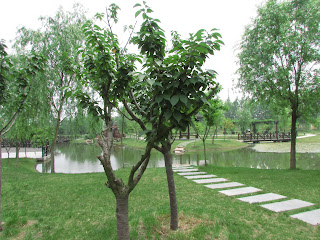
After that, we toured the beautiful school garden of Shuren School. It was a huge garden, complete with stone sculptures, a wondrous waterfall and even a beautifully built pavilion. We were all amazed that this was the garden of a school!
Next, we proceeded to visit the infamous Xinhua Book Store (新华书局). We heard that this book store is very popular among the Chinese. It's basically the Chinese equivalent of Singapore's Popular Book Store. Xinhua Book Store had several levels, each level selling different things. We noticed that there were very little English books, probably because most of the locals do not read English for leisure purposes. There were Korean and Japanese language textbooks, perhaps for the locals to study, enabling them to go to Korea and Japan to do business. We also noted that Xinhua Book Store sold basketballs. This told us that the Yangzhou locals probably engaged in basketball frequently and that this sport was quite popular among the people. In conclusion, we learnt that looking through a book shop can tell a lot about a country's culture.
After that, we went for dinner and a trip to the local supermarket to get some food and drinks.
✧DAY 5, 30th May
On Day 5, we got to visit the former residence of Zhu Ziqing. (朱自清故居) We learnt that this residence was built in the Qing Dynasty and I was quite fascinated with the structure of it. We learnt that this style of structure was actually the classic Yangzhou "三合院" style of building. We also got to know that the 朱自清故居 is a patriotism education base, as Zhu Ziqing was a patriotic writer. I think that the 朱自清故居 contributes to traditional culture as the building style of his house was classic and can influence people to be more patriotic and love the country.
Then, we visited Dongguan Street (东莞历史文化街). It is an ancient alley and street in the center of Yangzhou. There's quite a number of shops in Dongguan Street and life was very vibrant and carefree there. My CID group mates and I bought some souvenirs there for our families and friends. From what I saw, Dongguan Street was a street full of culture and heritage. Small handicrafts and traditional crafts were sold in many shops and there was an antique, or 古色古香 feel about the place. I was fascinated by the deep sense of culture around this street.

Next, we went to see Slender West Lake (瘦西湖). It's a well-known scenic spot in the city of Yangzhou and also is a national park in China. The lake is surrounded by many weeping willows and is a gorgeous attraction. I had felt very relaxed while walking around it.

We then visited Dong Quan Men Alley (东圈门历史街). This is a quiet ancient back alley that contains a host of sites well worth visiting. We learnt that the alley's main entrance gate dates back to the Qing Dynasty. Small restaurants and shops line the alley, yet it lacks any sense of commercialization.Some food was also sold there, and we even saw a street vendor make sweets on the spot. She drizzled syrup in intricate images and pictures on pieces of translucent paper, then as it got into place, they would be ready to be eaten! I think that this is good as once in a while, we should really appreciate the culture and little things around us, rather than focus on the buzz of a busy commercialized area.
✧DAY 6, 31st May
On Day 6, we returned to Shanghai. We then went to the Shanghai Science and Technology Museum (上海科技馆). It was a fascinating and interesting place! This museum is modernized and very large. It even has a 3D movie theater! The museum has 13 permanent exhibitions and my group mates and I went to the Spectrum of Life nature exhibit which imitates the scenery of Yunnan Province and displays its diversity of creatures. After, we even watched a short movie in the IMAX 3D theater, which was really exciting as our seats could be elevated and there were some special effects like water sprays, etc.

Next, we paid a visit to Tian Zi Fang (田子坊). It is an arts and crafts enclave that has developed from a renovated residential area in the French Concession area of Shanghai. Tian Zi Fang is well-known for its small craft stores, coffee shops, trendy art studios and narrow alleys. I felt that it was a very quaint and interesting part of Shanghai, as it was very artsy and expresses more about the culture in Shanghai.
Then, we visited the infamous French Concession (法租界). We learnt from 包导 that the French Concession was a foreign concession in Shanghai from 1849 to 1943. Although there was some re-development over the last few decades, the French Concession still has a distinct character and air about it and is famous for the preservation of local 石库门 architecture.

After visiting the French Concession, we travelled to Chenghuang Miao (城隍庙), a temple located within the old walled city. The 城隍庙 not only refers to the temple complex, but also the traditional district of commerce surrounding the temple. There are over a hundred stores and shops in this area and most of the store buildings are nearly a century old!
✧DAY 7, 1st June
Our first stop was Qibao Ancient Town (七宝古镇). I felt that it was quite like the ancient streets in Yangzhou, however, we noticed that Qibao Ancient Town had quite a number of costume businesses, where you dress in traditional Chinese clothing and take photographs. Instead, the ancient streets in Yangzhou had no such businesses. We believe that this is because Shanghai has more tourists than Yangzhou, as it is a more globalized city. This is probably why Shanghai hosts more of costume businesses, which are more targeted at tourists.
Later, we visited the Shanghai Museum (上海博物馆). It's a museum of ancient Chinese art and is considered one of China's first world-class modern museums. We saw a lot of ancient antiques of China, e.g. ceramics, calligraphy, furniture and paintings. We have all learnt a lot about the history of China through this trip to the museum.
Next stop is the famous Oriental Pearl Tower (东方明珠塔)! We're all really excited for this trip as we have heard prior to the trip that the Oriental Pearl Tower is an extremely tall structure and has a 263 meters viewpoint. It felt truly surreal to be standing on transparent ground and look down at the beautiful scenery beneath! We had a bird's eye view of The Bund, even.


Next, we had to leave Shanghai for Singapore. I felt truly reluctant to be leaving China as over the 7 days, I had started to understand China's customs and ways of life. It had also been great fun travelling different places and learning all about China's traditional culture, everyday customs and modern way of life. We may have encountered a number of customs that differ from what we are used to, in Singapore, however we have learnt to be courteous, patient and considerate and try to understand those customs. It has been an incredibly beneficial trip to China that opened my eyes to many new different ways of living and I am very grateful to my school for organizing OELP, giving us the chance to experience and immerse ourselves in China's culture and modern customs.
Thursday, 30 April 2015
☾ Festivals In China
There are many festivals celebrated in China, as festivals are a very important part of China's culture. I will be researching on some different festivals celebrated in China.


- Chinese New Year, or 春节, is the most widely known festival celebrated by most people in China. According to Wikipedia, CNY is an important Chinese festival celebrated at the turn of the Chinese calendar. It is considered a major holiday for the Chinese. Within China, regional and customs concerning the celebration of CNY vary greatly. However, most often, during CNY, it is a custom for Chinese families to gather for the annual reunion dinner. Many Chinese families also engage in spring cleaning, which they believe will sweep away the bad luck from the previous year, as it will be a new year, a fresh start for them. Windows and doors will be decorated with red-coloured paper-cuts and couplets, as red is a colour representing prosperity and good fortune to the Chinese. Other customs include lighting firecrackers and giving money in red-packets.
- The Lantern Festival has been of great significance since the Western Han Dynasty. During the Lantern Festival, children go out at night to temples carrying paper lanterns and solve riddles on the lanterns, also known as 猜灯谜. These lanterns symbolise people letting go of their past selves and having a fresh start. The lanterns are mostly red to symbolise good fortune as well. In Hong Kong, the Lantern Festival is commercialised as the Chinese equivalent of Valentine's Day. It is not to be confused with the Mid-Autumn Festival, which is sometimes known as the Lantern Festival in Singapore and Malaysia.
- The Qingming Festival is also known as Tomb-Sweeping Day. Its name in Chinese suggests a time for people to go outside and enjoy the greenery of springtime, also known as 踏青 in Chinese. However, it is mostly noted for the connection with the tending of family graves. However, I'm not sure why this occasion is a celebrated festival.
- The Duanwu Festival is also known as the Dragon Boat Festival. Ways of celebrating this festival is to eat 粽子, which are sticky rice treats wrapped in bamboo leaves, and drinking realgar wine, also known as 雄黃酒, as well as racing dragon boats.
- The Qixi Festival, known as 七夕, is a Chinese festival that celebrates the annual meeting of the cowherd and the weaver girl in Chinese mythology. It is also widely known as the Chinese Valentine's Day. The festival originated from 织女 and 牛郎, who were the weaver girl and cowherd, respectively.
- The Ghost Festival, also 中元节, is a traditional Chinese festival in which ghosts and spirits, including those of deceased ancestors, come out from the "lower realm". On that day, Taoists and Buddhists will perform rituals to to transmute and absolve the sufferings of the deceased. Activities during the Ghost Festival include preparing ritualistic food offerings, burning incense, and burning joss paper. Elaborate meals, frequently vegetarian, would be served with empty seats for each of the deceased in the family, treated as if they were still living, and to show respect to their deceased family members. Other ways of celebrating this festival include releasing miniature boats and paper lanterns on water, signifying giving directions to the lost ghosts and spirits of the ancestors or deities.
- The Mid-Autumn Festival is known as 中秋节. It celebrates gathering of the family, giving thanks and praying for various things, such as for babies, longevity, or for a good future. Brightly lit lanterns are carried around and moon cakes are made and shared. The senior person in that household would cut the moon cake into pieces and distribute them to the family members, signifying family reunion.
- Another celebrated festival is the Laba Festival, also known as 腊八节. It is customary on that day to eat Laba congee and Laba garlic. This festival is used to commemorate the Gautama Buddha's enlightenment at age 35.
THANK YOU FOR READING! (:
Tuesday, 14 April 2015
☀ Is Merlion A Good Icon For Singapore? [ZIQIU]
✿ ZIQIU'S REFLECTION
<IS MERLION A GOOD ICON FOR SG?>
In my opinion, the Merlion is not a good icon for Singapore. Though many think that it is the one icon that can represent Singapore, I believe otherwise.
Thank you for reading(:
<IS MERLION A GOOD ICON FOR SG?>
In my opinion, the Merlion is not a good icon for Singapore. Though many think that it is the one icon that can represent Singapore, I believe otherwise.
- According to Wikipedia, "Merlions do not feature in any local folklore or myths of Singapore, and was only used in Singapore initially as the logo for the tourism board." Firstly, what's most important about Singapore as a country is not just a small aspect of its economy income (in this case, the tourism board), but rather the culture of Singapore, represented by old folklores and stories of Singapore. These stories represent the growth of Singapore over the years and that is what really can represent Singapore as a whole. There is more to the growth of Singapore than just a statue of the Merlion.
- Singapore was officially independent on 9 August 1965. The Merlion was made official on 15 September 1972, one not-so-significant date. This hence does not connect the Merlion with any of the significance in Singapore. Hence, I do not think that the Merlion should be viewed as the national icon of Singapore.
- According to Wikipedia, "it has become a marketing icon". We should not simply view the Merlion from economical points of how it is regarded as a "national icon", because the Merlion statue being popular in all parts of the world does not make it a good national icon, as it has not been through the ups and downs of Singapore's growth, but has merely brought economy increase for Singapore.
- Wikipedia states that a national icon is something that can be symbolic of the nation. In my opinion, the Merlion does not represent anything very unique about our nation, making it a not-so good icon for Singapore.
- There are many other representative icons that I believe represents Singapore well. For example, the national anthem. It was composed in 1958, a few years before Singapore became independent. This can show that the national anthem has seen the ups and downs of Singapore when it became independent in 1965. I also think that it is a unique representation of Singapore as this song is something special to us as it conveys the message "Onward Singapore" representing the Singaporeans' pride, joy and hope as we progress with the nation.
Thank you for reading(:
Friday, 27 March 2015
Remembering LKY [ZIQIU'S BLOGWORK]

WHAT WE HAVE LEARNT ABOUT TANG DYNASTY'S GOLDEN ERA?
[art & culture]
- Paintings, e.g. landscape paintings and mountain-water paintings are not to reproduce exactly the appearance of nature but rather to grasp an EMOTION//ATMOSPHERE so as to catch the "rhythm" of nature.
- Pottery was exported to Arabia where it was highly priced. Chinese pottery during the Tang dynasty made significant advances.
- For poetry, its art flourished during the Tang dynasty. Poetry became an integral part of the Chinese culture. People who wished to pass the state/imperial exams had to study poetry.
These productions can be traded as they are valued by many other countries. There is a lot of interaction between the Chinese and people of other cultures. The Tang people were prosperous and content. The arts flourished during this era.
WHAT I HAVE LEARNT ABOUT MR LEE KUAN YEW
He has led Singapore from a third-world fishing village to a cosmopolitan metropolis, an economy hub buzzing with activity everyday all thanks to his leadership. He has made Singaporeans prosperous and thanks to Mr Lee Kuan Yew's bilingual programme and racial equality mindset, we have become appreciative of the arts and cultures of other people, allowing the arts to flourish in Singapore.
HOW CAN SINGAPORE BE SEEN AT ITS OWN VERSION OF THE "GOLDEN AGE"?
- People are content with their lives.
- Different arts and cultures flourish in Singapore and we Singaporeans appreciate and embrace them.
- Singapore is flourishing in prosperity.
- There is racial equality.
- We are a first-world metropolis.
THANK YOU FOR READING! (:
Thursday, 26 February 2015
Zi Qiu's Reflection
ZIQIU'S REFLECTION :D:
After last week's activity, where we were told to classify different situations into either Opportunities, Threats or None, I have definitely learnt a lot! I am also very amazed by China's accomplishments over the past years. China has seen an unprecedented economic growth over the last two decades.
{❃}
After last week's activity, where we were told to classify different situations into either Opportunities, Threats or None, I have definitely learnt a lot! I am also very amazed by China's accomplishments over the past years. China has seen an unprecedented economic growth over the last two decades.
{❃}
China has a huge population of 1.4 million people. This is an opportunity, as Singapore can hire people there who do not have jobs to work in Singapore, as foreign talent or workers.
{❃}
China also has a great land mass. This means a lot more space for office buildings, residential areas, infrastructure, etc. Hence, there is more free space for economic activities to be conducted, boosting China's economy. This is a threat, as more people will go to China where there is huge sufficient space to work and build factories etc, and thus, Singapore will lose business opportunities.
{❃}
China is endowed with natural resources, like coal, natural gas and steel. This can be an opportunity as we can buy these natural resources from them.
{❃}
China's corporate tax rate is one of the lowest tax rates in the world. This will attract foreign investors to come to invest. This can be both a threat and an opportunity. We can go to China and invest in their businesses. As a threat, more investors will choose to go to China for investing rather than Singapore. This will cause our economy to suffer.
{❃}
Chinese exports are relatively cheaper as well. Less countries are importing from countries like USA and even Americans are importing from China. This will be a threat to Singapore, as we may lose business opportunities, resulting in economy downfall.
Thank you for reading! =)
☺
Thursday, 12 February 2015
❃ Zi Qiu's Reflection ( 2 )
ONE-CHILD POLICY
The one-child policy started in China and was instituted on September 25, 1980. The law was set because in 1980, the new regime of Chinese leaders believed that forcibly restricting population growth would lead to greater economic prosperity. This policy restricts the majority of Chinese families to one child each, and if a child did not have a birth permit, the family would have to pay high fines, resulting in majority of families not wanting to have more than one child due to the punishments.
PROS OF THE POLICY
In the poor areas in China, there are far too many births and hence, if birth is controlled, quality of life will be raised. The parents will spend more attention and money on one child. Also, parents will not have to worry about feeding other children. Quality of life is improved and poverty can be eradicated.
Secondly, there is limited space in China and the number of population is constantly increasing, hence there is need for birth reduction.
It reduces competition for jobs, as places are limited.
CONS OF THE POLICY
It forces abortion and violates human rights. The proclamation of the International Conference on Human Rights in the year 1968 revealed that parents have the right to determine responsibly and freely the spacing and the number of children. When the one-child policy is executed, a lot of governments demand abortions once the pregnancy is found to have violated some regulations.
There will be an imbalance of males and females in the society. There will also be more unmarried males as there are lesser females.
There will be less people working and economy may suffer.
HOW I FEEL ABOUT THIS POLICY
I feel that this policy was very helpful in managing the birth rates. There is less poverty and stress weighing on the parents.
IN SINGAPORE
Personally, I feel that there is no need for the one-child policy in Singapore. Our birth rates are controlled and the quality of life here is mostly high. There is enough space here in Singapore and in fact, we need more births. The government is even rewarding families with births with packages like SG50 package, etc.
Thank you for reading!
Zi Qiu
The one-child policy started in China and was instituted on September 25, 1980. The law was set because in 1980, the new regime of Chinese leaders believed that forcibly restricting population growth would lead to greater economic prosperity. This policy restricts the majority of Chinese families to one child each, and if a child did not have a birth permit, the family would have to pay high fines, resulting in majority of families not wanting to have more than one child due to the punishments.
PROS OF THE POLICY
In the poor areas in China, there are far too many births and hence, if birth is controlled, quality of life will be raised. The parents will spend more attention and money on one child. Also, parents will not have to worry about feeding other children. Quality of life is improved and poverty can be eradicated.
Secondly, there is limited space in China and the number of population is constantly increasing, hence there is need for birth reduction.
It reduces competition for jobs, as places are limited.
CONS OF THE POLICY
It forces abortion and violates human rights. The proclamation of the International Conference on Human Rights in the year 1968 revealed that parents have the right to determine responsibly and freely the spacing and the number of children. When the one-child policy is executed, a lot of governments demand abortions once the pregnancy is found to have violated some regulations.
There will be an imbalance of males and females in the society. There will also be more unmarried males as there are lesser females.
There will be less people working and economy may suffer.
HOW I FEEL ABOUT THIS POLICY
I feel that this policy was very helpful in managing the birth rates. There is less poverty and stress weighing on the parents.
IN SINGAPORE
Personally, I feel that there is no need for the one-child policy in Singapore. Our birth rates are controlled and the quality of life here is mostly high. There is enough space here in Singapore and in fact, we need more births. The government is even rewarding families with births with packages like SG50 package, etc.
Thank you for reading!
Zi Qiu
Saturday, 31 January 2015
❃ Zi Qiu's reflection ( 1b ) Proverty in SG
Singapore recently ranked as the world's sixth most expensive city according to the Economist Intelligence Unit, and its property market is among the top 10, according to PricewaterhouseCoopers. However, this also means that there is quite a lot of people living in poverty, in Singapore.
During our last lesson, we watched a video where we saw the living conditions of foreign workers living in Orchard Road, one of the richest and most luxurious parts of Singapore. When we saw what their conditions were like, we were all very shocked. It turned out that their dormitories are all very dirty, hot and smelly. The quarters were extremely cramped and they didn't even have proper and clean toilets. Everything was so not the way I imagined living at Orchard Road, the central of Singapore.
Although we don't see many beggars in Singapore, there are still many families, in fact, more than 100,000 families are struggling in poverty, right here in Singapore.
In another lesson, we watched a video of a family with a single mother. Life was very difficult for her family as her family members all had to depend on only her salary to get by. They couldn't afford luxurious items or lavishly spend their money on things that they wanted. However, the mother was still strong and worked very hard for her children, taking up several jobs and even working into the wee hours of the morning. Her children also opened up blogshops selling squishies and other small and cute toys which they can get for very cheap prices at the nearby one dollar shop. They were also very cheerful and did not give up on life just like that. Instead, they worked hard and were not selfish, giving part of their money to their mother for housekeeping. They also earned their own pocket money to relieve stress of their mother.
This really touched me, and I feel that we are genuinely very lucky, being able to live in spacious homes, being able to buy what we liked, but yet many of us still complain. There are many poor kids who would love to switch places with us, and yet we take many things for granted.
We should learn from this lesson that we should not take our comfort for granted and always think for less unfortunate people.
During our last lesson, we watched a video where we saw the living conditions of foreign workers living in Orchard Road, one of the richest and most luxurious parts of Singapore. When we saw what their conditions were like, we were all very shocked. It turned out that their dormitories are all very dirty, hot and smelly. The quarters were extremely cramped and they didn't even have proper and clean toilets. Everything was so not the way I imagined living at Orchard Road, the central of Singapore.
Although we don't see many beggars in Singapore, there are still many families, in fact, more than 100,000 families are struggling in poverty, right here in Singapore.
In another lesson, we watched a video of a family with a single mother. Life was very difficult for her family as her family members all had to depend on only her salary to get by. They couldn't afford luxurious items or lavishly spend their money on things that they wanted. However, the mother was still strong and worked very hard for her children, taking up several jobs and even working into the wee hours of the morning. Her children also opened up blogshops selling squishies and other small and cute toys which they can get for very cheap prices at the nearby one dollar shop. They were also very cheerful and did not give up on life just like that. Instead, they worked hard and were not selfish, giving part of their money to their mother for housekeeping. They also earned their own pocket money to relieve stress of their mother.
This really touched me, and I feel that we are genuinely very lucky, being able to live in spacious homes, being able to buy what we liked, but yet many of us still complain. There are many poor kids who would love to switch places with us, and yet we take many things for granted.
We should learn from this lesson that we should not take our comfort for granted and always think for less unfortunate people.
Saturday, 24 January 2015
❃ Zi Qiu's Reflection ( 1a )
During our last lesson, I have learnt a lot about backgrounds of different people and how we should never carelessly make judgments without knowing people's background story.
From this lesson, I have deeply learnt that we should never simply judge a person without knowing their background story. We can never be sure by judging and instead, we should have different perspectives to understand something properly.
I am very grateful for this lesson that prepared us.
We were showed two pictures with different beggars begging for money. One depicted a man sitting by the road, asking for money. The other showed a disheveled-looking woman with a young baby, asking money from a man. Then, we were told to choose a person to help.
I chose the man sitting by the road. He seemed more desperate and he seemed to need just a little bit of money and it will make a big difference. Hence, I can make an immediate difference in someone's life. Meanwhile, although the young woman also needed the money, I can tell that it is not urgent or an emergency.
Later on, it was revealed that the man was actually robbed and needed one dollar to call his family so he could get home. The young woman was part of a scam group that staged it to gain pity and hence to con unsuspecting tourists and even locals of their money.
From this lesson, I have deeply learnt that we should never simply judge a person without knowing their background story. We can never be sure by judging and instead, we should have different perspectives to understand something properly.
I am very grateful for this lesson that prepared us.
Saturday, 17 January 2015
❃ Zi Qiu's Holiday
MY 2014 DECEMBER HOLIDAYS
During the December holidays, my family and I took a trip to the Bahamas Islands. They had mesmerisingly breathtaking views and the weather was absolutely delightful! The waters were not very chilly in the winter, but it definitely wasn't warm either. I would prefer to go during a warmer weather next time.
There are many various historic attractions and busy marketplaces in Nassau, which is the island we went to. It kept us very busy and I had such a fun time learning about the culture there. The people there were friendly, laid-back and very down-to-earth.
There were a lot of gorgeous beaches and the food was delicious! We ate a lot of Bahamas' specialty: seafood! We had fish, lobsters, crabs and conch, which I had tried for the very first time. We also got to try tropical fruits, rice, peas and potatoes. The flavours were exotic and very new to what I was used to eating in Singapore. However, it all tasted very fresh and succulent and I completely enjoyed the food in the Bahamas!
***
As my CCA was NCC, I also had to go for several camps in the December holidays. One camp that was really fun and educational was the FSD (freestyle drill) camp.
FSD is where you make up your own moves to several songs. River Valley's FSD team has been winning top awards for the past few years and it could even be said to be one of NCC's unique cultures, as we are quite known for our FSD.
At the camp, we learnt about a lot of fun things, like the different movements of FSD. The camp was very fun and contrary to what I originally thought, the camp wasn't "boring"! We bonded with our platoon mates and even got to make up our own routine to perform at the end of the camp.
Overall, it was an educational yet enjoyable experience and I have definitely learnt a lot from it!
ZIQIU :D
During the December holidays, my family and I took a trip to the Bahamas Islands. They had mesmerisingly breathtaking views and the weather was absolutely delightful! The waters were not very chilly in the winter, but it definitely wasn't warm either. I would prefer to go during a warmer weather next time.
There are many various historic attractions and busy marketplaces in Nassau, which is the island we went to. It kept us very busy and I had such a fun time learning about the culture there. The people there were friendly, laid-back and very down-to-earth.
There were a lot of gorgeous beaches and the food was delicious! We ate a lot of Bahamas' specialty: seafood! We had fish, lobsters, crabs and conch, which I had tried for the very first time. We also got to try tropical fruits, rice, peas and potatoes. The flavours were exotic and very new to what I was used to eating in Singapore. However, it all tasted very fresh and succulent and I completely enjoyed the food in the Bahamas!
***
As my CCA was NCC, I also had to go for several camps in the December holidays. One camp that was really fun and educational was the FSD (freestyle drill) camp.
FSD is where you make up your own moves to several songs. River Valley's FSD team has been winning top awards for the past few years and it could even be said to be one of NCC's unique cultures, as we are quite known for our FSD.
At the camp, we learnt about a lot of fun things, like the different movements of FSD. The camp was very fun and contrary to what I originally thought, the camp wasn't "boring"! We bonded with our platoon mates and even got to make up our own routine to perform at the end of the camp.
Overall, it was an educational yet enjoyable experience and I have definitely learnt a lot from it!
ZIQIU :D
Subscribe to:
Posts (Atom)